Market Overview: Skin-Friendly and High-Performance Adhesive Tapes Transforming Healthcare
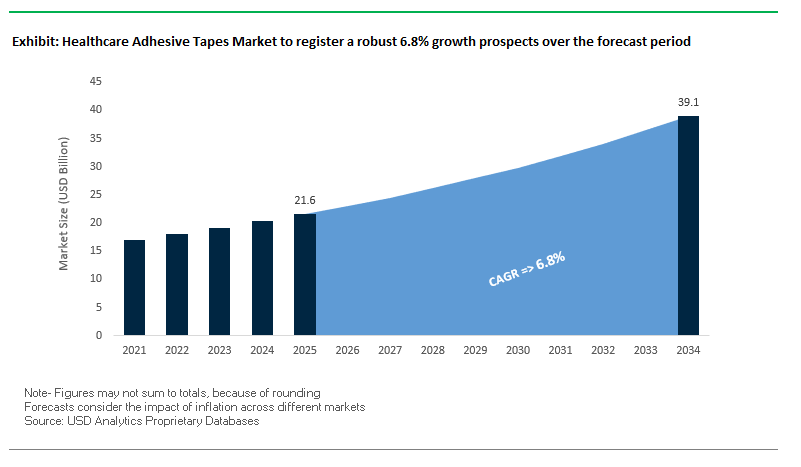
The Global Healthcare Adhesive Tapes Market is valued at USD 21.6 billion in 2025 and is projected to reach USD 39 billion by 2034, expanding at a CAGR of 6.8%. Adhesive tapes are an essential component in wound care, surgical procedures, medical device assembly, and wearable medical technologies. This market is defined by strict safety standards, the need for patient comfort, and the increasing demand for advanced, skin-friendly adhesives.
Healthcare providers and device manufacturers are prioritizing gentle, breathable, and conformable adhesives to reduce irritation during long-term wear. With the rise of wearable medical devices such as continuous glucose monitors and health sensors, demand for extended-wear medical tapes has surged. At the same time, innovations in antimicrobial coatings are making adhesive tapes safer by reducing the risk of infection at application sites.
Key Insights for Industry Professionals:
Market Value: USD 21.6B (2025) → USD 39B (2034).
CAGR: 6.8% driven by medical wearables, wound care, and surgical applications.
Materials Innovation: Acrylic and silicone adhesives improving moisture resistance and durability.
Patient Comfort: Demand for breathable, skin-friendly tapes supporting long-term wear.
Infection Control: Antimicrobial tapes gaining traction in surgical drapes and wound dressings.
Market Analysis: Recent Developments in the Healthcare Adhesive Tapes Industry
The Healthcare Adhesive Tapes Market is undergoing rapid transformation, with new product launches, acquisitions, and sustainability initiatives reshaping the competitive landscape.
In February 2023, 3M set a benchmark by launching a medical adhesive capable of sticking to skin for up to 28 days, doubling the wear time compared to industry norms. This innovation has accelerated adoption in wearable sensors and glucose monitors. By September 2024, industry reports highlighted the adoption of bio-based adhesives in medical tapes, aligned with global sustainability goals and consumer demand for eco-friendly medical products.
In February 2025, Johnson & Johnson MedTech expanded its sports medicine and soft tissue solutions through a distribution agreement with Responsive Arthroscopy. The same month, Johnson & Johnson acquired Shockwave Medical, strengthening its MedTech portfolio, including products requiring specialized adhesive tapes for patient monitoring. In March 2025, new pharmaceutical research highlighted growing demand for flexible lid stock in single-dose packaging, indirectly boosting the need for reliable medical tapes for securement.
Meanwhile, in May 2025, Klüber Lubrication (Freudenberg Group) invested USD 16.8 million in its Mysore, India plant, expanding its role in high-performance medical lubrication and indirectly influencing adhesive tape applications in medical devices. In July 2025, new healthcare reports emphasized the adoption of smart packaging technologies (QR codes, NFC, RFID) in medical supplies, signaling a convergence between adhesive tape innovation and digital healthcare tracking. By August 2025, DNP announced its participation at Medical Fair Thailand, where it introduced sustainable healthcare packaging, showing a global shift toward eco-friendly medical consumables.
Key Trends and Opportunities in the Global Healthcare Adhesive Tapes Market
Shift Towards Sustainable, Low-Solvent and Bio-Based Adhesives
The healthcare adhesive tapes market is experiencing a material innovation shift, as manufacturers reduce reliance on solvent-based adhesives and incorporate bio-based polymers to address both regulatory and environmental demands. Traditional solvent-heavy systems are being phased out due to volatile organic compound (VOC) emissions and occupational safety concerns. Leading suppliers are transitioning to water-based acrylics, hot-melt adhesives, and bio-derived polymers that deliver medical-grade adhesion while lowering carbon footprints.
Case studies highlight that leading producers are experimenting with bio-based polyurethane (PU) and silicone alternatives that not only meet ISO 10993 biocompatibility standards but also enhance patient comfort for long-term wear. This trend is particularly critical in wound care and wearable medical devices, where tapes must adhere securely without irritating sensitive skin. The growth avenue lies in aligning with sustainability mandates like the EU Green Deal and U.S. FDA guidance on safer adhesive chemistries, making eco-friendly tapes a differentiator for global healthcare suppliers.
Integration of Advanced Skin-Friendly and Long-Wear Technologies
Skin health and patient comfort are becoming decisive factors in healthcare adhesive tape design, especially as applications expand into long-term wearables for continuous glucose monitoring (CGM), cardiac telemetry, and advanced wound dressings. Manufacturers are adopting silicone gel adhesives and hydrocolloid-based tapes that provide gentle adhesion, minimize medical adhesive-related skin injury (MARSI), and can be painlessly removed.
Recent developments highlight next-generation soft silicone adhesives that maintain tack even after repeated repositioning, enhancing usability for both clinicians and patients. Additionally, new breathable backing materials paired with moisture-vapor transmission films ensure skin integrity during multi-day wear. This trend reflects the convergence of material science and patient-centric design, where performance metrics are defined not only by adhesion strength but also by dermatological safety and long-term biocompatibility.
Expansion into Wearable Medical Devices and Digital Health
The explosive growth of wearable medical devices is creating a major growth avenue for adhesive tape manufacturers. Devices such as continuous glucose monitors, ECG patches, and drug delivery systems require skin-contact adhesives that perform reliably for 3–14 days, balancing strong adhesion with comfort and breathability.
Reports highlight that the global wearables market is expanding at double-digit growth rates, directly boosting demand for medical-grade adhesive tapes designed for electronics integration and long-term skin contact. Leading brands are partnering with tape suppliers to co-develop solutions that integrate adhesive layers with sensors, batteries, and flexible electronics. This creates opportunities for tapes that not only adhere but also manage moisture, enable wireless signal transmission, and support patient mobility. For healthcare adhesive tape providers, this segment represents one of the most profitable niches, given its recurring revenue potential and alignment with digital health adoption worldwide.
Development of Specialty Tapes for Advanced Wound Care and Surgical Applications
A significant opportunity exists in the development of specialty adhesive tapes tailored for advanced wound dressings, ostomy care, and surgical drapes. As minimally invasive surgeries and chronic wound cases rise, there is growing demand for tapes with sterile barriers, antimicrobial coatings, and enhanced conformability to irregular anatomical surfaces.
Innovations include antimicrobial-embedded adhesives that reduce infection risk, and dual-layer tapes that combine strong anchoring with breathable outer layers. In surgical environments, the need for secure, sterile adhesion is driving adoption of high-performance drape tapes that resist fluids and maintain adhesion under challenging operating conditions. The wound care sector, in particular, offers strong long-term growth potential, as aging populations and diabetes prevalence increase the need for long-term, safe, and effective adhesive solutions.
Competitive Landscape: Leading Players in Healthcare Adhesive Tapes
The market is highly competitive, with global leaders investing in R&D, sustainability, and medical wearable integration to strengthen their positions.
3M Company develops medical tape with 28-day wear time
3M is a pioneer in medical adhesives, with over 55 years of skin adhesion science. Its portfolio covers wound care, surgical drapes, wearable sensors, and medical device tapes. In February 2023, it launched 3M Medical Tape 4578, capable of adhering for up to 28 days, doubling the industry standard. 3M’s strategy is centered on next-generation adhesives for wearables and operational efficiency, supported by heavy investments in R&D and sustainable skin adhesives.
Medtronic plc integrates adhesives into wearable medical devices
Medtronic, a global leader in medical technology, leverages adhesives across devices like insulin pumps and glucose monitoring systems. Its continuous glucose monitors require durable, skin-friendly adhesives for long-term patient comfort. Medtronic’s strategy emphasizes improving patient outcomes through integrated adhesives in devices, ensuring reliability in extended use. Its adhesive technologies are built into its products, ensuring seamless performance.
Johnson & Johnson strengthens MedTech adhesive portfolio through acquisitions
Johnson & Johnson is a trusted name in healthcare, supplying surgical tapes, wound care adhesives, and consumer medical products. In February 2025, the company acquired Shockwave Medical, expanding its MedTech capabilities. Its adhesive tapes are widely used in hospitals and clinics, while its acquisitions aim to expand innovation in medical devices. Johnson & Johnson’s strategic focus is innovation-driven growth and expanding adhesive applications in professional healthcare and consumer markets.
Nitto Denko is a leading materials science company with expertise in medical tapes, transdermal patches, and wearable adhesives. It has developed specialized adhesives that are gentle on skin and easily removable, making them ideal for long-term wear applications. Nitto’s strategic focus is to develop breathable, skin-friendly adhesives while investing in R&D for next-generation medical applications, ensuring patient comfort and safety.
Tesa SE develops precision adhesives for in-vitro diagnostics
Tesa specializes in diagnostic adhesives, providing spacer tapes and hydrophilic films that improve fluid distribution and accuracy in in-vitro diagnostics (IVD). These high-precision adhesive solutions are critical for test reliability in diagnostic devices. Tesa’s strategic focus is on innovation and quality in diagnostic tapes, continuously advancing materials that support point-of-care testing and medical research.
Healthcare Adhesive Tapes Market Share Insights
Wound Dressing Holds the Largest Market Share by Application in Healthcare Adhesive Tapes
Wound dressing applications represent 35% of the healthcare adhesive tapes market in 2025, making them the single largest driver of consumption. Medical tapes are essential for securing simple gauze pads, advanced foam dressings, and hydrocolloid solutions in both acute and chronic wound management, particularly in the treatment of diabetic ulcers and surgical wounds. Their dominance is linked to the increasing prevalence of chronic conditions, post-operative care requirements, and the growing elderly population. IV line and catheter securement follows closely with 25% share, underscoring the critical role of medical tapes in safely anchoring infusion devices and preventing site infections. Surgical applications demand highly specialized products such as antimicrobial tapes and sterile drape tapes, while diagnostic and patient monitoring requires skin-friendly, hypoallergenic tapes to attach electrodes and wearable sensors for continuous health tracking. Collectively, this segmentation demonstrates how wound care drives the largest volume, IV securement ensures procedural reliability, and surgery and diagnostics push innovation in high-performance medical tapes.
Hospitals Dominate Market Share by End-Use in Healthcare Adhesive Tapes
Hospitals account for 60% of end-use demand in the healthcare adhesive tapes market by 2025, reflecting their central role in patient care across emergency, surgical, critical care, and general wards. Hospitals are bulk purchasers and rely on adhesive tapes in nearly every procedure, from securing surgical incisions and drapes to routine wound dressing and IV catheter fixation. Their large patient throughput, combined with the diverse requirements of departments ranging from operating theaters to intensive care units, ensures their dominance. Home healthcare is emerging as the fastest-growing end-use segment, fueled by the global shift toward outpatient care, self-managed wound treatment, and the adoption of wearable medical devices in aging populations. Ambulatory surgical centers (ASCs) also contribute significantly, focusing on high-quality, infection-control-driven tapes for outpatient procedures. Specialty clinics such as dialysis centers and dedicated wound care facilities represent smaller but consistent demand. This segmentation highlights how hospitals dominate by scale and volume, while home healthcare emerges as the growth engine, and ASCs and clinics strengthen demand in focused, procedure-specific environments.
United States Healthcare Adhesive Tapes Market Accelerates with Innovations in Patient-Centric and Sustainable Solutions
The U.S. healthcare adhesive tapes market is shaped by a fragmented regulatory environment, with the FDA providing guidance for advanced medical tapes that offer enhanced hypoallergenic properties and superior adhesion. Technological advancements are driving innovations focused on patient comfort and functionality, including breathable tapes, gentle adhesion for fragile skin, and antimicrobial surfaces. Cutting-edge research incorporates nanomaterials like graphene to enhance strength and conductivity for wearable medical devices.
Corporate investments are significant, highlighted by the recent spin-off of Solventum from 3M, creating a dedicated entity for advanced healthcare adhesives. Key applications include wound care, surgical procedures, and patient monitoring, with wearable devices such as continuous glucose monitors (CGMs) increasing demand for tapes that endure movement and moisture. The market also emphasizes sustainability, with bio-based adhesives derived from renewable resources reducing reliance on petroleum-based materials.
Germany Healthcare Adhesive Tapes Market Driven by Stringent MDR Regulations and R&D Leadership
Germany’s healthcare adhesive tapes industry is governed by the EU Medical Device Regulation (MDR), effective 2021, which enforces rigorous safety and performance standards. This regulatory framework drives innovation, motivating manufacturers to produce high-quality, reliable adhesive solutions.
Technological innovation is robust, with companies like Lohmann specializing in smart patches and non-invasive sensor applications, such as continuous temperature monitoring. Germany’s strong R&D infrastructure and collaboration with medical device firms support complex die-cutting and high-performance bonding for medical diagnostics, ostomy care, and surgical applications. The country’s emphasis on engineering precision and high-value medical devices positions it as a global leader in healthcare adhesive tapes.
China Healthcare Adhesive Tapes Market Expands Through Government Support and Automation
China’s healthcare adhesive tapes market is influenced by governmental initiatives aimed at enhancing healthcare and promoting domestic manufacturing. Policies aligned with the “dual carbon” goal are encouraging greener raw materials and production processes for medical adhesives. Regulatory oversight by the National Medical Products Administration (NMPA) ensures adherence to safety standards, with foreign companies like Adhex aligning with ISO 13485:2016 and other international norms.
Technological advancements, including automation and AI integration, are improving production efficiency, while the push for domestic substitution of imported products fuels capacity expansion. Key applications are driven by the rapidly growing healthcare sector and an aging population, with demand concentrated in wound care, surgical applications, and patient monitoring devices. China’s strong manufacturing base ensures the availability of high-quality, high-performance medical adhesive tapes to meet domestic and export needs.
India Healthcare Adhesive Tapes Market Strengthened by PLI Scheme and Make in India Initiatives
India’s healthcare adhesive tapes market is witnessing strong growth, driven by the National Medical Devices Policy 2023 and schemes like the Production Linked Incentive (PLI), with over $400 million in financial outlay. These initiatives encourage domestic manufacturing, R&D, and innovation in high-performance medical adhesives.
Technological advancements include automated production and specialized tapes for surgical and personal care applications. Corporate investments, supported by the Make in India initiative, are expanding local manufacturing capacity, with players like Medilivescare Manufacturing producing elastic adhesive bandages for surgical and sports injuries. Key applications include surgical procedures, wound care, and the growing wearable medical device segment, fueled by expanding healthcare infrastructure and increasing affordability of medical devices.
Japan Healthcare Adhesive Tapes Market Advances with Precision Manufacturing and High-Performance Medical Solutions
Japan leads in precision manufacturing, with the healthcare adhesive tapes market supported by advanced production technologies. Regulatory policies emphasize safety and biocompatibility, promoting skin-friendly materials and high-quality performance.
Corporate expansions target specialized medical applications, with companies like Nitto Denko developing high-performance films and tapes for surgical, diagnostic, and first-aid uses. The market focuses on specialty and value-added products, incorporating superior barrier properties and IoT-enabled tracking in medical devices. Innovations such as easy-open tear notches and resealable closures address the needs of aging populations and single-person households, reinforcing Japan’s position as a leader in advanced healthcare adhesive solutions.
Brazil Healthcare Adhesive Tapes Market Driven by Wound Care, Surgery, and Sustainability Trends
Brazil’s healthcare adhesive tapes market is supported by government initiatives promoting sustainable practices and circular economy models. The National Solid Waste Policy encourages domestic recycling programs, indirectly influencing medical adhesive manufacturing.
Technological advancements are enhancing tape performance, with premium and specialized digital solutions emerging for medical and pharmaceutical applications. Key applications include wound care, surgical procedures, and patient monitoring, driven by an increasing number of surgical interventions. Sustainability is a growing focus, with global competitions like iFood-XPRIZE fostering innovations in biodegradable materials, a trend likely to shape the Brazilian healthcare adhesive tapes industry in the coming years.
Healthcare Adhesive Tapes Market Report Scope
Healthcare Adhesive Tapes Market
Parameter
Details
Market Size (2025)
$21.6 Billion
Market Size (2034)
$39 Billion
Market Growth Rate
6.8%
Segments
By Resin Type (Acrylic, Silicone, Rubber), By Backing Material (Paper, Fabric, Plastic), By Application (Wound Dressing, Surgery, IV Lines & Securement, Diagnostic & Patient Monitoring Devices, Others), By End-Use (Hospitals, Specialty Clinics, Ambulatory Surgical Centers, Home Healthcare)
Study Period
2019- 2024 and 2025-2034
Units
Revenue (USD)
Qualitative Analysis
Porter’s Five Forces, SWOT Profile, Market Share, Scenario Forecasts, Market Ecosystem, Company Ranking, Market Dynamics, Industry Benchmarking
Companies
3M, Johnson & Johnson Services, Inc., Cardinal Health, Inc., Lohmann GmbH & Co. KG, Medtronic plc, Smith & Nephew plc, Nitto Denko Corporation, Paul Hartmann AG, Avery Dennison Corporation, Henkel AG & Co. KGaA, B. Braun Melsungen AG, H.B. Fuller Company, Adhesives Research, Inc., Dynarex Corporation, Solventum (a spin-off from 3M)
Countries
US, Canada, Mexico, Germany, France, Spain, Italy, UK, Russia, China, India, Japan, South Korea, Australia, South East Asia, Brazil, Argentina, Middle East, Africa
Healthcare Adhesive Tapes Market Segmentation
By Resin Type
Acrylic
Silicone
Rubber
By Backing Material
Paper
Fabric
Plastic
By Application
Wound Dressing
Surgery
IV Lines & Securement
Diagnostic & Patient Monitoring Devices
Others
By End-Use
Hospitals
Specialty Clinics
Ambulatory Surgical Centers
Home Healthcare
Countries Analyzed
North America (US, Canada, Mexico)
Europe (Germany, UK, France, Spain, Italy, Russia, Rest of Europe)
Asia Pacific (China, India, Japan, South Korea, Australia, South East Asia, Rest of Asia)
South America (Brazil, Argentina, Rest of South America)
Middle East and Africa (Saudi Arabia, UAE, Rest of Middle East, South Africa, Egypt, Rest of Africa)
Top Companies in Healthcare Adhesive Tapes Market
3M
Johnson & Johnson Services, Inc.
Cardinal Health, Inc.
Lohmann GmbH & Co. KG
Medtronic plc
Smith & Nephew plc
Nitto Denko Corporation
Paul Hartmann AG
Avery Dennison Corporation
Henkel AG & Co. KGaA
B. Braun Melsungen AG
H.B. Fuller Company
Adhesives Research, Inc.
Dynarex Corporation
Solventum (a spin-off from 3M)
* List Not Exhaustive
Methodology
USDAnalytics employed a rigorous, multi-faceted research methodology to deliver actionable insights into the Global Healthcare Adhesive Tapes Market. The study integrated primary research through interviews with key stakeholders, including medical tape manufacturers, hospitals, specialty clinics, and wearable medical device providers, capturing first-hand insights on product innovations, skin-friendly adhesives, and long-wear technologies. Secondary research analyzed company reports, press releases, regulatory publications, patent filings, and healthcare journals to validate market drivers, material innovations, and sustainability trends. Market sizing and forecasting were derived from historical data, trend extrapolation, and econometric modeling, emphasizing high-growth areas such as wound care, surgical applications, IV securement, and diagnostic device tapes. Regional dynamics covering the United States, Germany, China, India, Japan, and Brazil were evaluated, highlighting regulatory frameworks, automation adoption, production expansion, and sustainable manufacturing initiatives. Competitive landscape analysis focused on leading players including 3M, Johnson & Johnson, Medtronic, Nitto Denko, and Lohmann, examining R&D investments, bio-based adhesive adoption, and integration with wearable technologies. This comprehensive methodology ensures industry professionals receive a reliable, forward-looking perspective on global market trends, technological advancements, and growth opportunities.
Deliverables:
Comprehensive Market Research Report (PDF and Excel) with detailed tables, charts, and interactive visualizations.
Country-Specific Forecasts & Analysis.
Segment-Wise Revenue Forecasts (2025–2034).
Competitive Analysis, Benchmarking, and SWOT Profiles.
Recent Developments & Innovation Tracker.
Executive Summary & Analyst Commentary.
Post-Purchase Analyst Support for Client-Specific Questions and Custom Data Requirements.
Table of Contents: Healthcare Adhesive Tapes Market
1. Executive Summary
1.1. Market Highlights
1.2. Key Findings
1.3. Global Market Snapshot
2. Healthcare Adhesive Tapes Market Landscape & Outlook (2025–2034)
2.1. Introduction to Healthcare Adhesive Tapes Market
2.2. Market Valuation and Growth Projections (2025–2034)
2.3. Market Drivers and Challenges
2.4. Recent Developments and Industry Trends
2.5. Regulatory and Safety Considerations
3. Innovations Reshaping the Healthcare Adhesive Tapes Market
3.1. Trend: Shift Towards Sustainable, Low-Solvent and Bio-Based Adhesives
3.2. Trend: Integration of Advanced Skin-Friendly and Long-Wear Technologies
3.3. Opportunity: Expansion into Wearable Medical Devices and Digital Health
3.4. Opportunity: Development of Specialty Tapes for Advanced Wound Care and Surgical Applications
4. Competitive Landscape and Strategic Initiatives
4.1. Mergers, Acquisitions and Strategic Alliances
4.2. R&D and Material Innovation
4.3. Sustainability and Strategies
4.4. Market Expansion and Regional Focus
5. Market Share and Segmentation Insights: Healthcare Adhesive Tapes Market
5.1. By Resin Type
5.1.1. Acrylic
5.1.2. Silicone
5.1.3. Rubber
5.2. By Backing Material
5.2.1. Paper
5.2.2. Fabric
5.2.3. Plastic
5.3. By Application
5.3.1. Wound Dressing
5.3.2. Surgery
5.3.3. IV Lines & Securement
5.3.4. Diagnostic & Patient Monitoring Devices
5.3.5. Others
5.4. By End-Use
5.4.1. Hospitals
5.4.2. Specialty Clinics
5.4.3. Ambulatory Surgical Centers
5.4.4. Home Healthcare
6. Country Analysis and Outlook of Healthcare Adhesive Tapes Market
6.1. United States
6.2. Canada
6.3. Mexico
6.4. Germany
6.5. France
6.6. Spain
6.7. Italy
6.8. UK
6.9. Russia
6.10. China
6.11. India
6.12. Japan
6.13. South Korea
6.14. Australia
6.15. South East Asia
6.16. Brazil
6.17. Argentina
6.18. Middle East
6.19. Africa
7. Healthcare Adhesive Tapes Market Size Outlook by Region (2025–2034)
7.1. North America Healthcare Adhesive Tapes Market Size Outlook to 2034
7.1.1. By Resin Type
7.1.2. By Backing Material
7.1.3. By Application
7.1.4. By End-Use
7.2. Europe Healthcare Adhesive Tapes Market Size Outlook to 2034
7.2.1. By Resin Type
7.2.2. By Backing Material
7.2.3. By Application
7.2.4. By End-Use
7.3. Asia Pacific Healthcare Adhesive Tapes Market Size Outlook to 2034
7.3.1. By Resin Type
7.3.2. By Backing Material
7.3.3. By Application
7.3.4. By End-Use
7.4. South America Healthcare Adhesive Tapes Market Size Outlook to 2034
7.4.1. By Product
7.4.2. By Application
7.4.3. By End-Use
7.4.4. By Type
7.5. Middle East and Africa Healthcare Adhesive Tapes Market Size Outlook to 2034
7.5.1. By Resin Type
7.5.2. By Backing Material
7.5.3. By Application
7.5.4. By End-Use
8. Company Profiles: Leading Players in the Healthcare Adhesive Tapes Market
8.1. 3M Company
8.2. Johnson & Johnson Services, Inc.
8.3. Cardinal Health, Inc.
8.4. Lohmann GmbH & Co. KG
8.5. Medtronic plc
8.6. Smith & Nephew plc
8.7. Nitto Denko Corporation
8.8. Paul Hartmann AG
8.9. Avery Dennison Corporation
8.10. Henkel AG & Co. KGaA
8.11. B. Braun Melsungen AG
8.12. H.B. Fuller Company
8.13. Adhesives Research, Inc.
8.14. Dynarex Corporation
8.15. Solventum
9. Methodology
9.1. Research Scope
9.2. Market Research Approach
9.3. Market Sizing and Forecasting Model
9.4. Research Coverage
9.5. Data Horizon
9.6. Deliverables
10. Appendix
10.1. Acronyms and Abbreviations
10.2. List of Tables
10.3. List of Figures
Healthcare Adhesive Tapes Market Segmentation
By Resin Type
Acrylic
Silicone
Rubber
By Backing Material
Paper
Fabric
Plastic
By Application
Wound Dressing
Surgery
IV Lines & Securement
Diagnostic & Patient Monitoring Devices
Others
By End-Use
Hospitals
Specialty Clinics
Ambulatory Surgical Centers
Home Healthcare
Countries Analyzed
North America (US, Canada, Mexico)
Europe (Germany, UK, France, Spain, Italy, Russia, Rest of Europe)
Asia Pacific (China, India, Japan, South Korea, Australia, South East Asia, Rest of Asia)
South America (Brazil, Argentina, Rest of South America)
Middle East and Africa (Saudi Arabia, UAE, Rest of Middle East, South Africa, Egypt, Rest of Africa)
The Global Healthcare Adhesive Tapes Market is projected to grow from USD 21.6 billion in 2025 to USD 39 billion by 2034, at a CAGR of 6.8%. Growth is driven by rising demand in wound care, surgical applications, and the adoption of adhesive tapes for wearable medical devices.
Silicone, hydrocolloid, and bio-based adhesives provide gentle adhesion, reduce skin irritation, and enable multi-day wear. These technologies are critical for continuous glucose monitors, cardiac telemetry, and wound dressings, ensuring patient comfort and minimizing medical adhesive-related skin injuries.
Healthcare tape manufacturers are shifting to low-solvent and bio-based adhesives to reduce VOC emissions, meet ISO 10993 standards, and comply with sustainability mandates. Eco-friendly adhesives offer the dual benefit of regulatory compliance and enhanced patient safety.
Wound care dominates with 35% market share, followed by IV line and catheter securement at 25%. Surgical drapes, ostomy care, and diagnostic devices also drive demand, emphasizing high-performance, sterile, and antimicrobial adhesive solutions.
The rapid growth of wearables like glucose monitors, ECG patches, and drug delivery systems is fueling demand for long-lasting, skin-friendly tapes. Adhesives now integrate with sensors and electronics, balancing strong adhesion, breathability, and patient mobility, creating a high-value niche for tape manufacturers.